Load Balancing and High Availability for Small-Scale Applications
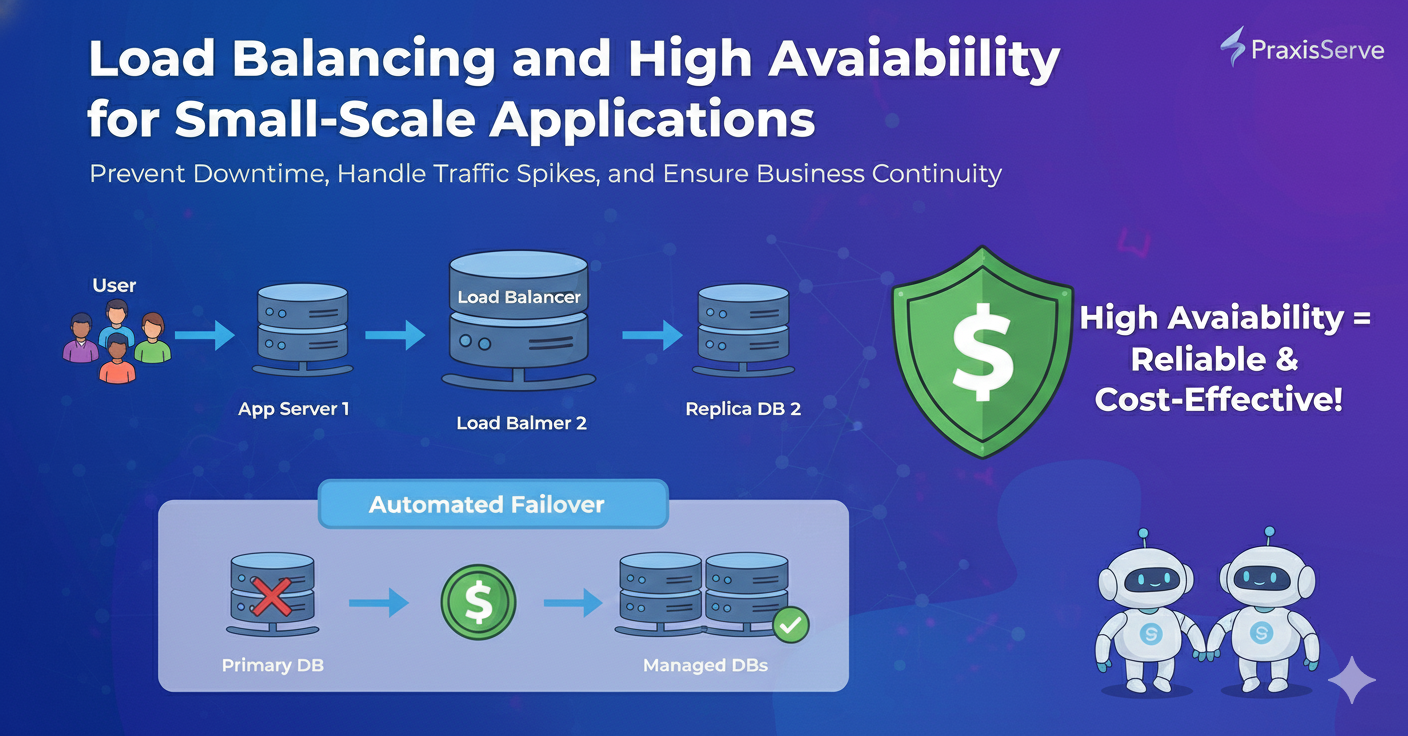
Load Balancing and High Availability for Small-Scale Applications
Prevent Downtime, Handle Traffic Spikes, and Ensure Business Continuity.
As your application gains traction, relying on a single server becomes a major liability. If that server fails, or if a sudden traffic spike overwhelms its capacity, your application goes down—and client trust goes with it. The solution lies in two core infrastructure concepts: **Load Balancing** and **High Availability (HA)**.
These practices are no longer reserved for large enterprises. They are accessible and vital strategies for any freelance developer or small team managing applications that require reliability and predictable performance.
Understanding Load Balancing
A Load Balancer is a device or software that acts as a reverse proxy, distributing network traffic evenly across a group of backend servers (or server cluster). It ensures no single server is overworked, maximizing speed and capacity.
- Traffic Distribution: Load balancers use algorithms (like round-robin or least connections) to intelligently route new requests.
- Health Checks: They continuously monitor the health of the backend servers. If a server fails, the load balancer automatically stops sending traffic to it until it recovers.
- SSL Termination: Modern load balancers can handle SSL/TLS encryption and decryption, freeing up your backend servers to focus purely on application logic.
Practical Example: Using an AWS Application Load Balancer (ALB), Azure Load Balancer, or Nginx running as a load balancer on a high-spec VM.
Achieving High Availability (HA)
High Availability means designing your system to operate continuously without failure for a long period of time. Load balancing is a component of HA, but true HA involves redundancy at all critical layers.
- Redundant Compute: Deploy multiple identical instances of your application (behind a load balancer) so if one fails, the others immediately pick up the traffic.
- Multi-Zone Deployment: For cloud users, deploy your redundant instances and databases across multiple Availability Zones (AZs). This protects against failure in a single data center.
- Redundant Database: Never run a production database on a single instance. Use master/replica configurations (or Managed Services) for immediate failover.
- Automated Failover: Utilize features like Auto Scaling Groups (AWS) or Managed Instance Groups (GCP) to automatically replace failed instances.
Key Principle: Eliminate all single points of failure (SPOFs).
Cost-Effective HA Tips for Small Teams
You don't need a massive cluster to start benefiting from HA:
- Managed Services: Use cloud provider managed services (e.g., AWS RDS, Azure Database) for databases, as HA, failover, and backups are built-in and often more cost-effective than managing it yourself.
- Small Redundancy: Start with just two small, mirrored application servers behind a low-cost cloud load balancer. This provides huge protection against downtime.
- Serverless (Lambda/Functions): Serverless architectures are inherently highly available, as the cloud provider manages all scaling and redundancy.
- Cloud DNS: Utilize services like AWS Route 53 or Cloudflare for advanced traffic routing and basic failover checks.
Focus: Invest in redundancy for critical components first (application servers and database).
Need Help Designing a Highly Available Architecture?
Designing a reliable, highly available architecture requires expertise in networking, cloud services, and redundancy planning. For freelancers and small teams, this level of infrastructure design can be complex and time-consuming.
PraxisServe specializes in implementing cost-effective load balancing and high availability solutions on AWS, Azure, and GCP, ensuring your applications are always accessible and performing optimally. Let us build your resilient infrastructure.
Need Help with This?
Our team is ready to assist you with implementation and support.