Fortifying Your Defenses: Network Security Best Practices for Small Teams
Fortifying Your Defenses: Network Security Best Practices for Small Teams
Protect Your Applications and Data from Cyber Threats in the Cloud and On-Premise.
In today's interconnected world, network security is not just an option—it's a fundamental necessity. For freelancers and small tech teams, the perimeter of your network is the first line of defense for your applications, data, and client trust. A single vulnerability can lead to devastating data breaches, operational downtime, and reputational damage.
Whether your infrastructure resides entirely in the cloud, on-premise, or in a hybrid environment, implementing robust network security best practices is paramount. This guide will cover essential strategies to fortify your defenses.
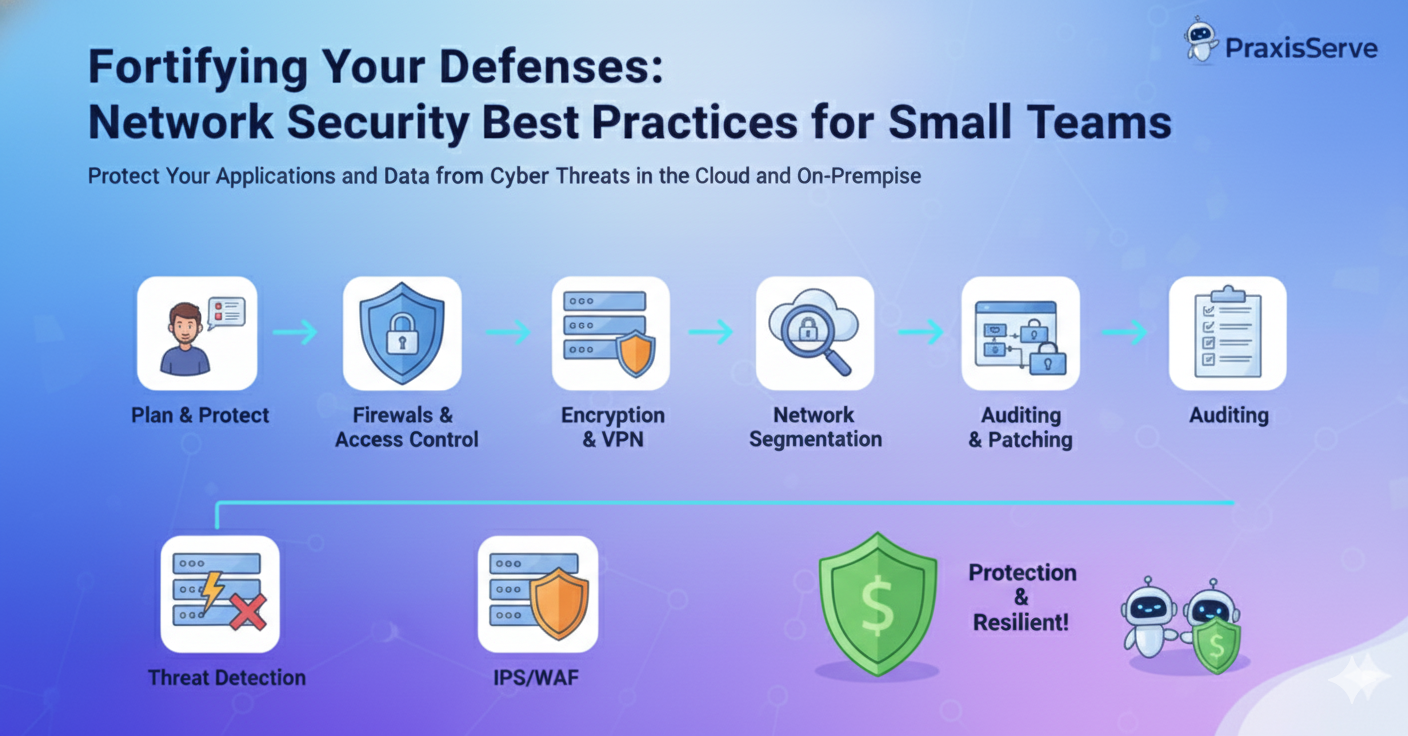
1. Implement Strong Firewalls & Security Groups
Your firewall is the gatekeeper of your network. Configure it strictly.
- Default Deny: Start by blocking all incoming and outgoing traffic, then explicitly allow only what is absolutely necessary.
- Least Privilege Access: Only open ports and allow access from specific IP addresses or ranges that legitimately need to connect.
- Cloud Security Groups/NACLs: Leverage cloud-native tools (AWS Security Groups/NACLs, Azure Network Security Groups, GCP Firewall Rules) to control traffic at the instance and subnet level.
Focus: Minimize your attack surface by keeping unnecessary ports closed.
2. Secure Network Traffic with Encryption
Encrypting data in transit protects it from eavesdropping and tampering.
- HTTPS/TLS: Always use HTTPS for all web traffic. Implement SSL/TLS certificates for your websites and APIs.
- VPNs (Virtual Private Networks): Use VPNs for secure remote access to your internal networks or cloud environments.
- Internal Communication: Encrypt traffic between services, especially for sensitive data flowing between databases and application servers.
Key: Assume an attacker might intercept your network traffic.
3. Implement Network Segmentation
Divide your network into smaller, isolated segments to contain potential breaches.
- VPCs/Subnets: Use Virtual Private Clouds (VPCs) or Virtual Networks (VNets) and subnets to logically separate different environments (e.g., production, staging, development).
- DMZ (Demilitarized Zone): Place public-facing servers (web servers, load balancers) in a separate network segment from your backend databases and application servers.
- Isolate Databases: Never expose your databases directly to the public internet. Access them only from authorized application servers.
Benefit: If one segment is compromised, the attacker's access is limited.
4. Regular Auditing & Vulnerability Scanning
Security is an ongoing process, not a one-time setup.
- Network Scanners: Use tools (e.g., Nmap, OpenVAS) to scan your network for open ports, misconfigurations, and known vulnerabilities.
- Log Monitoring: Centralize and monitor network traffic logs for suspicious patterns or unauthorized access attempts. Set up alerts for critical events.
- Security Updates: Ensure all network devices, operating systems, and application software are kept up-to-date with the latest security patches.
Focus: Proactively identify and fix weaknesses before they can be exploited.
5. Implement Intrusion Detection/Prevention Systems (IDS/IPS)
For an added layer of defense, consider IDS/IPS solutions.
- IDS (Detection): Monitors network traffic for malicious activity or policy violations and alerts you.
- IPS (Prevention): Actively blocks detected malicious activity in real-time.
- WAF (Web Application Firewall): Protects web applications from common attacks like SQL injection and cross-site scripting (XSS). Cloud providers offer managed WAFs.
Benefit: Provides real-time threat detection and mitigation.
Concerned About Your Network Security? PraxisServe Can Help.
Building and maintaining a secure network infrastructure can be complex, especially with evolving threats and the intricacies of cloud environments. For freelancers and small teams, security expertise is often a stretch.
PraxisServe offers comprehensive network security services, including firewall configuration, VPN setup, vulnerability assessments, and managed WAF solutions. We ensure your digital assets are protected, allowing you to focus on your core business with peace of mind.
Need Help with This?
Our team is ready to assist you with implementation and support.